
Skip to content

Latest news:

On-Site visit September 3rd, 2026: Solar Thermal Installation in Bari, Italy

On-Site visit July 16th, 2026: Solar Thermal Installation in Bari, Italy

On-Site visit June 3rd, 2026: Solar Thermal Installation in Bari, Italy

European Commission highlights solar thermal as a strategic European technology in list of immediate actions to address the crisis in the Middle East

Online event February 5: Solar Thermal in the Heat Auction submission process

  • How to decarbonize
  • World Wide Projects
  • Absolicon solutions
  • How to decarbonize
  • World Wide Projects
  • Absolicon solutions
  • EN
  • SV
  • ES

MORE

Process heat is industry’s next big climate issue

  • 2025-09-15

The EU’s CSRD directive requires companies to report detailed plans for how they will reduce their own emissions – not only by purchasing green electricity, but also by replacing the fossil fuels that power the factories. Here, the process heat is at the center.

The three categories of emissions

How companies should count their emissions is regulated in the “Greenhouse Gas Protocol” with detailed rules maintained by the World Business Council for Sustainable Development (WBCSD) and the World Resource Institute (WRI). It divides emissions into three categories:

Scope 1 is the companies’ own emissions from their own boilers, their own cars and travel. For Absolicon’s customers, the majority of scope 1 comes from the natural gas that is burned to produce process heat.

Scope 2 is emissions from purchased electricity. Electricity was previously produced mainly with coal power, but this has changed. Most large companies now buy electricity from wind power. According to GHG, electricity does not need to be produced at the same time as it is consumed, and by signing Power Purchase Agreements (PPAs) with wind and solar farms, the large companies have almost completely eliminated their emissions in Scope 2.

Scope 3 are the emissions caused by the company’s purchase of raw materials and the use of the products. For example, for a soft drink manufacturer, Scope 3 is emissions from the production of the sugar used, as well as the electricity in the refrigerated counter in a store that sells the soft drink and the recycling of the soda bottle.

From electricity to heat – the real challenge

Most companies have already managed to reduce their Scope 2 emissions by signing renewable electricity contracts. But in Scope 1 – the own emissions from boilers and processes – development has in many cases come to a standstill. Globally, enormous amounts of natural gas and oil are still burned to produce the heat that is absolutely crucial in everything from breweries to food production.
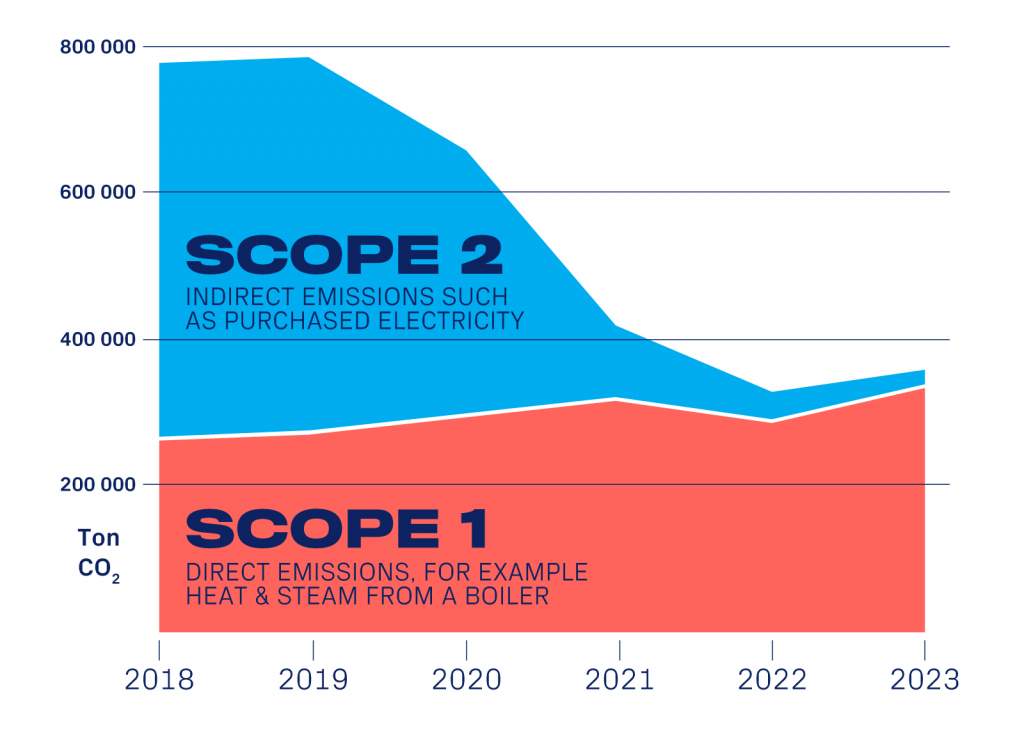
An environmental report from a typical multinational food company shows how its own emissions are going up, but that total emissions have decreased because they buy electricity from wind power and PV.

Alternatives to fossil fuels already exist

To meet the requirements and reduce its climate footprint, the industry needs to take the next step. Some of the most promising solutions are:

  • Solar collectors for process heat – Absolicon’s technology produces heat and steam up to 160°C, ideal for the food and beverage industry.
  • Heat storage – enables the storage of solar heat to run production even at night.
  • Combinations of technologies – biofuels, heat pumps and electric boilers can complement solar heat and create flexible, long-term sustainable energy systems.

An opportunity to take the lead

For many companies, the transition can feel complex. But that is precisely why those who act first will also be those who strengthen their competitiveness. Companies that already show a clear plan to replace fossil fuels with sustainable alternatives position themselves as the winners of the future – both to investors, customers and their own employees.

Read more

Thermal Energy Storage >>
Absolicon T160 Solar Collector >>
Corporate sustainability reporting – European Commission >>

Share:

On-Site visit September 3rd, 2026: Solar Thermal Installation in Bari, Italy

Read the article
2026-05-05

On-Site visit July 16th, 2026: Solar Thermal Installation in Bari, Italy

Read the article
2026-05-05

Absolicon Solar Collector AB
Fiskaregatan 11, SE-871 33
Härnösand, Sweden

Terms & Conditions
Privacy policy
Cookies

Phone: +46 611-55 70 00

E-mail: info@absolicon.com

Org.nr: 556929-1957

VAT: SE556929195701

Certified sustainability and quality

We use cookies on our website to give you the most relevant experience by remembering your preferences and repeat visits. By clicking “Accept”, you consent to the use of ALL the cookies. However you may visit Cookie Settings to provide a controlled consent.
Cookie settingsACCEPT
Privacy & Cookies Policy

Privacy Overview

This website uses cookies to improve your experience while you navigate through the website. Out of these cookies, the cookies that are categorized as necessary are stored on your browser as they are essential for the working of basic functionalities of the website. We also use third-party cookies that help us analyze and understand how you use this website. These cookies will be stored in your browser only with your consent. You also have the option to opt-out of these cookies. But opting out of some of these cookies may have an effect on your browsing experience.
Necessary
Always Enabled

Necessary cookies are absolutely essential for the website to function properly. This category only includes cookies that ensures basic functionalities and security features of the website. These cookies do not store any personal information.

Non Necessary

Any cookies that may not be particularly necessary for the website to function and is used specifically to collect user personal data via analytics, ads, other embedded contents are termed as non-necessary cookies. It is mandatory to procure user consent prior to running these cookies on your website.

Save & Accept
GroupCreated with Sketch.
  • Renewable heat
    • Decarbonize industrial production
    • Decarbonize District Heating
    • Solar thermal energy
    • Thermal energy storage
    • Solar thermal calculator
  • Absolicon solutions
    • Decarbonization Consulting Services
    • Solar Thermal Implementation
    • Absolicon Technology
    • Solar Applications
    • Production line
  • Investor relations
    • Corporate governance
    • Financial reports
    • News archive
  • Press & News
    • News archive
    • Newsletter
    • Press material
    • Webinar Series
  • About & Contact
    • Our story
    • Values & vision
    • Organization
    • Career & student
    • Contact us
  • Renewable heat
    • Decarbonize industrial production
    • Decarbonize District Heating
    • Solar thermal energy
    • Thermal energy storage
    • Solar thermal calculator
  • Absolicon solutions
    • Decarbonization Consulting Services
    • Solar Thermal Implementation
    • Absolicon Technology
    • Solar Applications
    • Production line
  • Investor relations
    • Corporate governance
    • Financial reports
    • News archive
  • Press & News
    • News archive
    • Newsletter
    • Press material
    • Webinar Series
  • About & Contact
    • Our story
    • Values & vision
    • Organization
    • Career & student
    • Contact us
  • Terms & conditions
  • Privacy policy
  • Cookies
  • Facebook
  • LinkedIn
  • Terms & conditions
  • Privacy policy
  • Cookies
  • Facebook
  • LinkedIn