Background and challenge
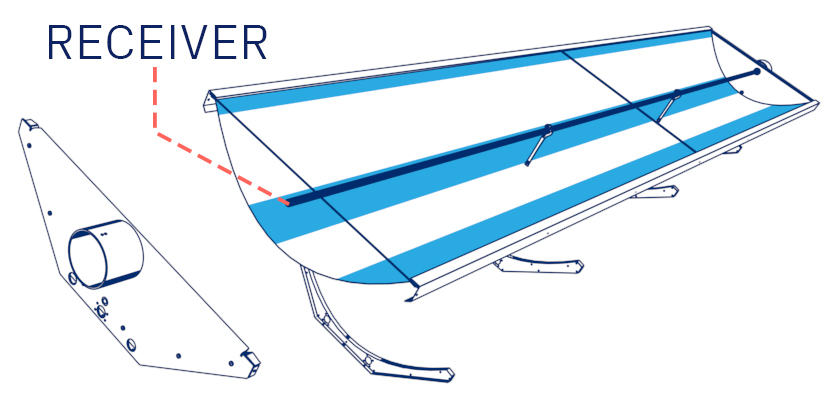
Parabolic trough collectors concentrate sunlight onto a receiver tube, where the solar energy is transferred to a heat-transfer fluid. The performance of the receiver is therefore an important factor in the overall efficiency and cost of a concentrated solar thermal system.
Conventional receivers typically use a single absorber tube. Optical losses through reflection and radiation, as well as uneven solar flux around the tube, can limit performance and create temperature differences and thermal stresses. Previous research has investigated secondary reflectors, modified geometries and other methods to improve collector performance, but there remains potential to improve the receiver itself.
DETECTIVE addresses this challenge through an innovative tube-bundle cavity receiver. Instead of one conventional absorber tube, several smaller tubes are arranged to form a cavity. Solar radiation entering the cavity can undergo multiple reflections between the tubes, increasing absorption while reducing radiation losses. The smaller tubes also provide a larger heat-transfer area and are expected to distribute the concentrated solar flux more evenly.
The goal is to increase collector efficiency while enabling smaller solar fields, reduced capital requirements and improved cost competitiveness. This could also make concentrated solar thermal systems easier to integrate at industrial sites where available land is limited or expensive.
Absolicon’s contribution
Absolicon is the industrial partner in DETECTIVE and contributes experience from the development, manufacturing and commercialization of parabolic trough solar collectors. The proposal allocates 18 person-months of work to Absolicon across the project.
Absolicon contributes to defining the technical and commercial requirements for the new receiver, including input to the initial design constraints, final prototype design and later optimization. The company also contributes to the design of the experimental campaign and the assessment of test results, as well as system-level studies, life-cycle assessment and techno-economic evaluation.
A central responsibility for Absolicon is Task 3.4, Large-scale manufacturing assessment and go-to-market strategies. Here, Absolicon leads the work to identify suitable manufacturing routes for scaling up the DETECTIVE receiver and to develop a strategy for bringing the technology towards commercial deployment. The final go-to-market strategy, Deliverable D8, is led by Absolicon and scheduled for the end of the project.
Absolicon also contributes market data, manufacturing knowledge and experience from industrial-scale solar thermal technology to help ensure that the developed receiver is not only technically effective but also suitable for cost-effective production and future commercialization.
Expected results and impact
DETECTIVE starts from Technology Readiness Level (TRL) 2 and aims to reach TRL 5 by developing the concept through modelling, prototype construction and testing in a relevant environment. Two prototype receivers are planned, with one installed and evaluated under real solar conditions at CIEMAT’s Plataforma Solar de Almería in Spain.
Alongside the technical development, the consortium develops techno-economic models and a life-cycle assessment to evaluate the receiver at system level, including applications for both power generation and industrial process heat. System integration studies consider process heat applications at temperatures of up to 400°C.
The project is expected to contribute to:
- A new tube-bundle cavity receiver designed, modelled, prototyped and experimentally validated for linear concentrating solar collectors.
- Higher solar collector efficiency through increased absorption and reduced reflection and radiation losses.
- More even heat distribution in the receiver, potentially reducing temperature gradients and thermal stresses.
- Reduced solar-field size and improved cost-efficiency, supporting lower capital requirements and lower cost of renewable heat and power.
- Techno-economic and environmental assessment of the new receiver compared with existing solutions.
- Scalable manufacturing methods designed with future commercial production in mind.
- A go-to-market strategy and development pathway towards further technology maturation and eventual commercial deployment.
- Broader use of concentrated solar thermal technology for renewable electricity and sustainable industrial process heat.
News, results and resources
KTH Royal Institute of Technology | Project page >>
Politecnico di Torino | Project page >>
CETPartnership | Project page >>
Absolicon awarded funding for DETECTIVE and another research project >>