
TRAINING explores how district heating networks, and the buildings connected to them, can make better use of stored heat. The goal is to use more renewable heat, such as solar heat, while reducing costs and peak demand. Absolicon contributes experience and data from large-scale solar heat connected to district heating in Härnösand, Sweden.
The project brings together eight universities, research institutes and companies from Norway, Sweden and Germany. Using real data from case studies in Trondheim, Härnösand and Kassel, the partners are developing methods, digital tools and business models that help energy companies use their existing pipes, buildings and storage tanks to store heat. The full name of the project is Thermal energy storing and digitalization in district heating to enable transition to renewable and resource efficient energy systems.
Project overview
| Project period | December 2023 – November 2026 |
|---|---|
| Project status | Ongoing |
| Funding | Swedish Energy Agency (Energimyndigheten), within the international CETPartnership Joint Call 2022. |
| Project coordinator | NTNU (Norwegian University of Science and Technology), Norway |
| Absolicon’s role | Industrial partner. Absolicon provides data from a large solar heating plant with heat storage connected to district heating, and works on storage assessment and system modelling. |
Background and challenge
District heating supplies heat to homes and other buildings through networks of underground pipes. There are around 10,000 district heating networks in Europe, meeting around 12% of the EU’s heat demand. To phase out fossil fuels, these networks need to use more renewable and surplus heat.
Solar heat is produced when the sun shines, but the demand for heat is highest on cold winter mornings. These peaks are often covered by expensive backup boilers. Storing heat solves part of the problem, but large storage facilities are costly to build.
District heating systems also have storage capacity that is rarely used today. The water in the pipes and the buildings themselves can hold heat for several hours, with very small changes in indoor temperature. Heat pumps, rooftop solar panels and electric vehicles add further flexibility. However, there is no established way to assess, prioritise and control these options. There are also few business models for sharing the benefits between energy companies and building owners.
Absolicon’s contribution
Absolicon is an industrial partner in the project. One of the three case studies is the Högslätten Solar Thermal Park in Härnösand, Sweden. There, Absolicon’s concentrating solar collectors supply heat to the local district heating network.
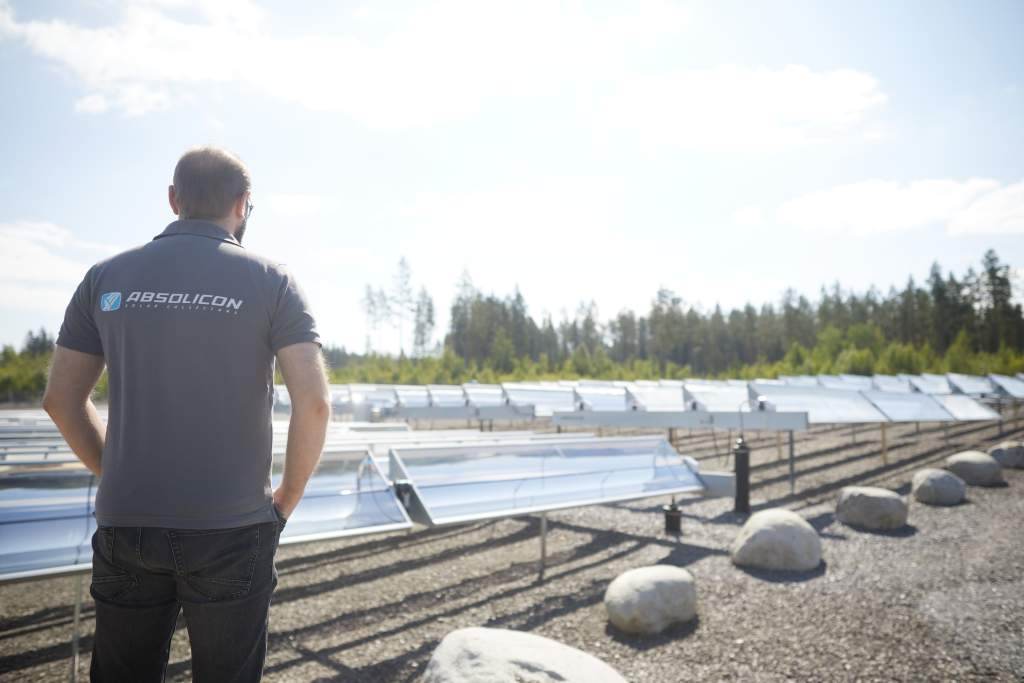
Absolicon contributes measurement data and experience from designing and building large solar fields. Absolicon’s work focuses on assessing heat storage potential and on designing and modelling district heating systems with solar heat and storage. Absolicon also takes part in following up the case studies and in sharing the results.
Expected results and impact
TRAINING will develop new methods and digital tools and test them in real systems in Norway, Sweden and Germany. The aim is to show how district heating can become more renewable and cost-efficient through better use of heat storage and flexibility, in many cases without large new investments.
The project is expected to contribute to:
- A simple method to estimate how much heat a district heating system can store in buildings, pipes, tanks, pits and the ground, and how much this can reduce peak demand
- Control systems based on machine learning that coordinate buildings and the heat network, using energy prices and weather forecasts
- Greater use of solar heat and other renewable or surplus heat, and less need for costly peak boilers
- New knowledge on how heat pumps, solar panels and electric vehicles can help balance the heat and electricity systems
- Business and pricing models that share the benefits between energy companies and building owners
- A stronger knowledge base for integrating large-scale solar heat and storage into district heating across Europe
Funding
Absolicon receives co-funding from the Swedish Energy Agency (Energimyndigheten) covering 45% of its eligible project costs. TRAINING is part of the Clean Energy Transition Partnership (CETPartnership) Joint Call 2022, co-funded by the European Commission under Horizon Europe, with partners in Norway and Germany funded by their national funding agencies.

![]()
News, results and resources
Norwegian University of Science and Technology | TRAINING >>
CETPartnership | Project description >>
