

INDHEAP, Optimal Solar Systems for Industrial Heat and Power, develops and demonstrates hybrid solar systems that combine solar thermal and photovoltaic technologies to provide both heat and electricity for industrial processes. The project focuses on mid-temperature applications up to 250°C and on making renewable energy easier to integrate into existing industrial sites.
By combining solar thermal, photovoltaics, energy efficiency, thermal energy storage and smart control, INDHEAP aims to demonstrate how industrial heat and power demand can be supplied more efficiently while reducing energy use, costs and emissions. A full-scale demonstration system will be implemented at TotalEnergies’ lubricants blending facility in Valdemoro, Spain, where the concept will be validated at Technology Readiness Level 7 (TRL7).
Background and challenge
Industrial processes require large amounts of both heat and electricity, with many low- and medium-temperature processes still dependent on fossil fuels. Integrating renewable energy into existing industrial facilities is challenging because heat and electricity demand vary over time, industrial sites have physical and operational constraints, and new systems must meet technical, regulatory and economic requirements.
INDHEAP addresses these challenges by developing an integrated approach combining solar thermal (ST), photovoltaic (PV) technologies, thermal energy storage and electric heating. The project studies how energy efficiency, waste heat recovery and demand flexibility can first reduce industrial energy demand, before optimizing the combination and sizing of renewable technologies.
A central part of the concept is a flexible electrically boosted thermal energy storage system, known as e-TES. The storage system connects solar heat and renewable electricity with the industrial process and enables energy to be stored and supplied according to production demand. The project also develops methods for selecting the optimal balance between solar thermal and PV based on technical, economic and environmental criteria.
Absolicon’s contribution
Absolicon Solar Collector AB is one of the 13 partners in the INDHEAP consortium and contributes solar thermal expertise to the development of the hybrid industrial energy concept.
Within the project, improved solar thermal collectors are being tested for operation at higher temperatures as part of the development of technologies for industrial applications. This work supports the overall objective of integrating efficient solar thermal generation with photovoltaics, thermal storage, electric heating and advanced control systems.
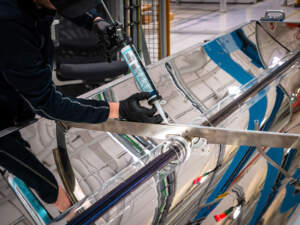
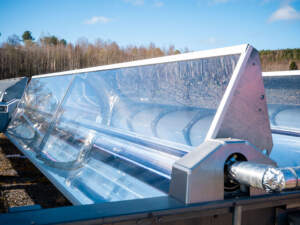
The developed technologies will ultimately be brought together in the INDHEAP demonstration system at the TotalEnergies facility in Valdemoro, Spain. The planned prototype includes solar thermal capacity of up to 300 kWth, photovoltaic capacity of up to 20 kWp and an e-TES system with storage capacity of up to 1 MWh. The system will be validated through operation in a real industrial environment.
Expected results and impact
INDHEAP aims to demonstrate that solar thermal and photovoltaic technologies can work together effectively to meet industrial heat and electricity demand, supported by energy storage, energy efficiency measures and intelligent system control.
The project is expected to contribute to:
- Validated hybrid ST-PV solutions for industrial processes requiring temperatures up to 250°C.
- Improved energy efficiency, including better use of waste heat and demand-side flexibility.
- Reduced energy use, costs and emissions through increased use of renewable heat and electricity.
- Development of flexible thermal energy storage, PV integration solutions, improved solar thermal collectors and smart control systems.
- Practical experience from a real industrial demonstration, supporting the transition from research and development towards commercial deployment.
- Scalability and replication of the INDHEAP concept across industrial sectors, particularly in Southern Europe and the MENA region.
- Reduced dependency on fossil fuels and further development of sustainable industrial heat solutions.
At the project’s mid-term milestone, energy assessments and modelling had already shown that targeted energy-efficiency measures, particularly waste heat recovery, could reduce heat demand by up to 20% at the sites studied. The project also reports that integrating solar technologies and electric heating could reduce energy costs by up to 40% in the assessed scenarios.
The project has also progressed from methodology and system design towards implementation. The integration concept for the Valdemoro demonstration site has been developed, construction and site-preparation activities have started, and the project is advancing detailed engineering of the solar systems, storage, controls and monitoring infrastructure.
Funding

INDHEAP is funded by the European Union through the Horizon Europe Research and Innovation Programme under grant agreement No. 101136140. The project has an EU contribution of €7 million.
News, results and resources
